
Getting started with your Airbnb business requires a big leap of faith upfront: making the initial investment. Understandably, investing in a short-term rental property makes a lot of people nervous and raises all sorts of questions. Is this really a good investment? What cities are the best investments? How will I find a property worth investing in?
We’ve put together this comprehensive article to answer all your questions and guide you through making a sound Airbnb investment decision. We’ll define what exactly an Airbnb investment is, the pros and cons of investing in Airbnb properties, and which are the best U.S. cities to buy an Airbnb property. Let’s get to it!
Don’t see the form to download our Airbnb Business Plan? Click here.
What does “Airbnb investment” mean?
Put simply, an “Airbnb investment” is when you purchase a property with the intention of renting it to short-term tenants through Airbnb for a profit. With four million Airbnb hosts worldwide, short-term vacation rental properties have become an extremely popular and fruitful form of passive income.
Though most Airbnb hosts start managing a property as a part-time job, many grow to own multiple properties they manage full-time. Whatever your career and income situation may be, there is a way to make Airbnb investing work for everyone.
Pros and cons of investing in Airbnb properties
Like any type of investment, there are pros and cons to investing in Airbnb properties and it’s important to be aware of these risks and benefits before committing. Below are some of the pros and cons to consider when you first set out to become an Airbnb host.
Pro: Passive income
The most obvious and probably most attractive benefit of investing in an Airbnb property is the potential for passive income. Passive income is defined as a revenue stream that doesn’t require you to be actively involved to make a profit. A traditional nine to five job is not passive income because the amount you earn is directly related to how much you work. An Airbnb property is considered passive income because you earn money through bookings and though it does require some work on your part, the amount of work you put in is not directly related to how much you earn.
Passive income is a great way to boost your income on top of your regular job or replace your income altogether. In fact, many people invest in an Airbnb property as a “side hustle” and end up taking it on as their full-time job.
Con: High operating costs
Managing an Airbnb property comes at a cost. You have to pay for things like utilities, wifi, decor, regular cleanings, maintenance, and potentially hiring additional staff members. All of these costs would be assumed by a long-term tenant if you didn’t choose the short-term vacation rental route. We don’t say this to scare you away, it’s just important to know what to expect before jumping into your Airbnb business and be financially prepared for these expenses.
Pro: Some expenses are tax-deductible
Because you manage your property as a short-term rental business, a lot of expenses can be deducted from your taxes. Marketing, advertising, accounting fees, insurance, and other expenses may be tax-deductible.

Many Airbnb hosts aren’t aware of the tax-deductible expenses which can have a big impact on your income. This allows you to write off some overhead costs and maximize your earning potential. As laws vary depending on the state, we recommend consulting a tax professional.
Con: Higher down payment
The required down payment for a vacation rental property is notably higher than that required for a primary residence. You usually need to put at least 10% down on vacation rental properties but it can get up to 25% or even higher depending on the strength of your application. That is to say, you should be prepared to make a hefty investment upfront on just the down payment alone.
Next, you’ll have to invest in quality furniture and decor, repairs, marketing, etc. Start-up costs for an Airbnb business are significant but if you choose the property and location wisely, you may be in for a great return on investment.
Pro: Higher revenue during peak season
Renting to short-term tenants through Airbnb gives you a lot of flexibility on how much you can charge in rent. You don’t have to lock yourself into one rate for a long contract like with long-term tenants. Instead, you can capitalize on the high seasons of the area and adjust your pricing to reflect trends in tourism.
If your property is located in a great area with high demand, there is no reason to not benefit from that! The only risk here is that your income is not guaranteed in the same way it t would be with a long-term tenant. There is no assurance that your property will be booked so though you have a higher earning potential, you have to accept the risk of instability.
Con: Airbnb properties can be time consuming
Managing an Airbnb property is not a walk in the park. They can take up a lot of your time if you don’t have the right resources to streamline your workflow. Using Airbnb management software, like Lodgify, will make your job as an Airbnb host as easy as possible. This software helps you manage all your bookings, tasks, finances, and guest communications from one online centralized platform to save you time.
Plus, the Airbnb channel manager connects all your listings on the top online travel agencies (such as Airbnb, Vrbo, and Expedia) to automatically sync your calendars and avoid double bookings.
Investing in real estate for Airbnb vs. long-term rental
There are some big differences between renting to short-term tenants through Airbnb and having long-term tenants (typically defined as six months or longer). Naturally, both options have advantages and disadvantages which should be considered.
Airbnb rentals require more day-to-day involvement
When you rent to long-term tenants, there isn’t a ton of work for you to take care of on a regular basis. Besides routine maintenance and the occasional emergency, long-term rentals won’t take as much of your attention. You aren’t responsible for regular cleaning, supplying and changing out linen, managing check-ins and check-outs, or informing guests about the area during their stay. There is much more of a “set it and forget it” element with long-term rentals.

Whereas with an Airbnb rental those tasks mentioned above will be your regular responsibility (or the responsibility of someone you delegate it to). Does that mean it is inherently more difficult to manage an Airbnb compared to a long-term rental? No. It’s just a matter of making the decision that works best with your lifestyle/availability.
Inconsistent income, but higher earning potential
Let’s address the elephant in the room. Obviously, with long-term rentals, you can rely on the consistency of a tenant paying rent every month (if they’re a good tenant!). You don’t have to worry about marketing the property and booking guests because you know you will always make the same amount every month.
But the downside of consistency is having to settle for the exact same amount of money coming in every month. That means you’re missing out on potentially much higher earnings during high seasons. What you would pay to rent a condo in Aspen during ski season is going to be drastically different than low season rent.
With Airbnbs you can drastically increase your profit margin by fluctuating the rent depending on the season. The drawback? There is no guarantee that your property will book and it’s very unlikely (or feasible) that your property will be booked every night of every month. You will have to block off days for cleaning and maintenance after all. But with big risks often come big rewards. It’s up to you to choose what you value more: consistency or potentially higher profit margins.
Vicinity of transportation and tourist attractions
A location that has a high likelihood of booking a long-term tenant is not necessarily a good place for an Airbnb property. Long-term tenants are typically looking for something that is near their workplace, well-connected, and fit for long-term stays in the way of amenities.

Tourists, on the other hand, are looking to have a good time. They want to be near tourist attractions, restaurants, the airport, etc. All these things should be considered before investing in an Airbnb property.
How to find the best properties to invest in Airbnb?
Being such a large investment, you want to be sure you invest in a property that will yield a great return on investment without too much work on your part. But how do you go about finding worthwhile properties? A lot of it comes down to researching and visiting properties until you find the right fit for your budget and business goals. Below are a few tips to get you started.
Use online investment analytics tools
The future success of an Airbnb property can be predicted by a few different indicators. AirDNA has an incredible tool that allows you to work out the average daily rate, occupancy rate, and projected revenue of an Airbnb property in a specific zip code. It gives you a look into how active properties in that ZIP code are performing to get an idea of how your Airbnb business would stack up.
Another really great tool to take advantage of when thinking about investing in an Airbnb property is Mashvisor. They can help you calculate analytics like cash-on-cash return and capitalization rate on homes in your specified ZIP code. Resources such as these can greatly decrease the amount of time you spend researching a location and boost your confidence in your Airbnb investment.
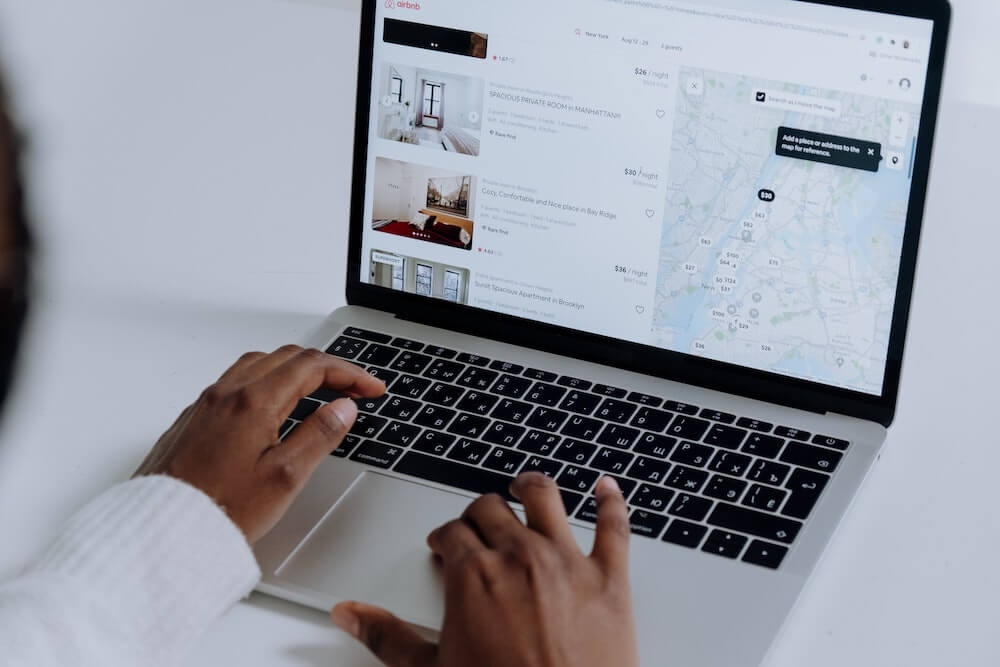
Browse Airbnb
Already have some potential locations in mind? Hop on Airbnb and take a look at what is already being offered in the area. While looking through the listings, ask yourself a few questions:
- What are these properties charging per night? And how does that compare to the average price of properties in the area?
- How many reviews do they have (this gives a glimpse into how many bookings they are getting)?
Though you shouldn’t base your investment decision solely on a peruse through Airbnb, it can be an insightful place to start.
Choose your realtor wisely
It’s best to work with a realtor with experience in the short-term vacation rental property industry. They will be better able to help you find a property with short-term vacation rental potential and have your best interest in mind. They have more of an understanding of what elements make a property vacation rental worthy so you can find the best property in the best location for your Airbnb business.
Best U.S. cities for Airbnb investment in 2022
Airbnb has 5.6 million listings across the globe… It’s been around since 2007 and it’s pretty safe to say it isn’t going to disappear any time soon. That said, some U.S. states have imposed strict laws on Airbnb hosts and some states have banned Airbnb altogether. For this reason, it’s crucial to do your research and make sure you invest in a property and location that will yield a good return on your investment.
It’s tempting (and common) to purchase a property in a location that’s meaningful to you… maybe it’s your hometown, your favorite vacation spot, or the location of an event you like. But just because you think it’s a great spot doesn’t mean your Airbnb business will thrive.
Cities to avoid
At the start of your location research process, you should keep in mind that there are some cities where Airbnb is very restricted. The following cities have either passed laws seriously limiting Airbnb rentals or banned them altogether:
- Calabasas, California
- New York City, New York
- San Francisco, California
- Honolulu, Hawaii
- New Orleans, Louisiana
- Las Vegas, Nevada
If one of these cities was on your radar, spend some time digging into the Airbnb laws of the area first… they could potentially limit your ability to operate your short-term rental business with Airbnb.
Cities to invest in
On the flip side, some cities have proven to be great Airbnb investments. Below we’ve listed some of the best cities for Airbnb investment in 2022 based on AirDNA’s best places to invest report.
In regards to U.S. large cities, the top five cities to invest in 2022 are:
- Nashville, Tennessee with 6,123 active short-term rental listings and revenue potential of $126,331
- Lahaina, Hawaii with 5,053 active short-term rental listings and revenue potential of $78,273
- Koloa, Hawaii with 1,674 active short-term rental listings and revenue potential of $66,518
- Kihei, Hawaii with 4,669 active short-term rental listings and revenue potential of $65,500
- Charleston, South Carolina with 2,107 active short-term rental listings and revenue potential of $60,182

Then, for U.S. medium cities, these five cities are the best to invest in:
- Yosemite National Park, California with 391 active short-term rental listings and revenue potential of $130,346
- St. John, U.S. Virgin Islands with 811 active short-term rental listings and revenue potential of $95,030
- Saco, Maine with 124 active short-term rental listings and revenue potential of $71,131
- Slidell, Louisiana with 106 active short-term rental listings and revenue potential of $38,806
- Waco, Texas with 582 active short-term rental listings and revenue potential of $34,710
Finally, for U.S. small cities, these five cities are great investments:
- Hana, Hawaii with 93 active short-term rental listings and revenue potential of $88,869
- Indian Hills, Colorado with 14 active short-term rental listings and revenue potential of $85,418
- Elizaville, New York with 16 active short-term rental listings and revenue potential of $83,126
- Kekaha, Hawaii with 30 active short-term rental listings and revenue potential of $71,785
- Catawba, North Carolina with 10 active short-term rental listings and revenue potential of $69,426
Should you invest in Airbnb properties?
Investing in Airbnb properties is a great way to build a source of passive income that you can rely on long into the future. How much? Find out with our short-term rental income calculator.
Keep in mind that there are some risks though, plus a big initial investment is required to start an Airbnb business. Despite this, the potential profits more than make up for it. The most important takeaway is to do your research so you know you are investing in a property and a location that will be successful on Airbnb.
Don’t see the form to download our Airbnb Business Plan? Click here.
Disclaimer: Lodgify is an Airbnb Preferred Software Partner. This post, including any claims or statements within, is solely from Lodgify and is not endorsed by, directly affiliated with, authorized, or sponsored by Airbnb in any way.